
Battle of the roasting chestnuts
Tips, tricks, inspiration, and encouragement for storytellers of all stripes

Greetings from Sarasota—
On my trip to Pensacola a couple weeks back, one of my colleagues—our tour manager, Kari—kept getting text alerts.
This was pre-Thanksgiving, mind you.
And her alert was the tinkly opening notes of Mariah Carey’s seminal holiday hit, “All I Want for Christmas is You.”
After the fourth or so Mariah-lert in a five minute span, I jokingly let her have it.
“It’s not even Thanksgiving, Kari! What are you doing?? No carols before the turkey is carved!”
She giggled. “Oh, all my decorations are already up.”
I shook my head in despair. Her phone tinkled a text. Mariah for the win.
Now, I have that song on my holiday playlist. It’s a banger. But I never hit play on that list until at least the day after Thanksgiving. And any radio station in my car that shifts to Bing and Burl and Frosty and Rudolph in early November? Embargoed!
But now that December has arrived, yes, I’m allowing that particular strain of music back into my ears.
So let me ask you this: which version of “Have Yourself a Merry Little Christmas” is your favorite? Who crushes “O Holy Night” the best? Whose “Silver Bells” ring the brightest?
I mean, Nat King Cole’s rendition of “The Christmas Song” is iconic. No one does roasted chestnuts like him. But that doesn’t stop every musical artist out there from trying. Holiday albums are one of the safest financial bets out there.
Here’s the thing: so many of my oral storytelling clients and students worry about how they sound. About getting it “right.”
Am I pausing enough? Talking too fast? Talking to slow?
Is my voice too high? Too nasally? Too low?
How’s my elocution? Do I have some annoying vocal tic—um or er or y’know—that I’m not even aware of?
I’ve memorized my story/speech/talk. Am I allowed to deviate? Do I sound too stuck in one way?
Part of my strategy to get them past these internal, self-judgmental blocks is to have them explore music.
Exploration 1: don’t be afraid of pauses.
Rare is the storyteller who goes too slow. Far more common is the storyteller or speaker who zooms through their words, racing to get off stage as quickly as possible, terrified of boring the listeners.
So, go listen to jazz and classical.
Miles Davis: It’s not the notes you play; it’s the notes you don’t play.
Claude Debussey: Music is the space between the notes.
Listen close and identify all the delicious silence.
If you’ve got your script in front of you, take advantage of your page turns. The audience needs those breaths and beats and pauses as much as you do.
Frankly, nothing is more compelling—more capable of getting an audience to lean forward—than full… resonant… potential-about-to-go-kinetic… silence.
Exploration 2: cover versions.
Pick a favorite composition or song. Maybe even your favorite holiday tune, which has been covered by umpteen recording artists. Use YouTube or Spotify or Apple Music to listen to as many versions of that one song as possible. Compare them. Contrast them. Luxuriate in the variety of interpretations.
Like Whitney Houston adjusting “Star Spangled Banner” from 3/4 time to 4/4 time, giving her amazing vocals more space to explore.
Like Tony Bennet slowing down “Fly Me to the Moon”—transforming it into a ballad—while Frank Sinatra swings it like Babe Ruth’s bat.
Like “Silent Night”—which to date has been recorded a cool 137,000 times!! OK, so maybe just compare a dozen or so “Silent Nights.” Solo, ensemble, a cappella, symphonic, piano, guitar, whatever. Same song. Wild array of interpretations.
Just like there’s no one right way to deliver “To be or not to be,” there’s no one right way to tell your story.
Are there wrong ways? Sure. If Mariah went flat (sacrilege to even suggest, I know!), she’d scrap that take and do another.
But tempo, dynamics, emotional point of view, phrasing… all of these can be leveraged based on your evolving skill and the needs of each particular audience.
Give it a whirl. Tell your story musically. See what unlocks. Not just inside your story…
… but inside you.
The Page&Stage Podcast: PREDICTOR
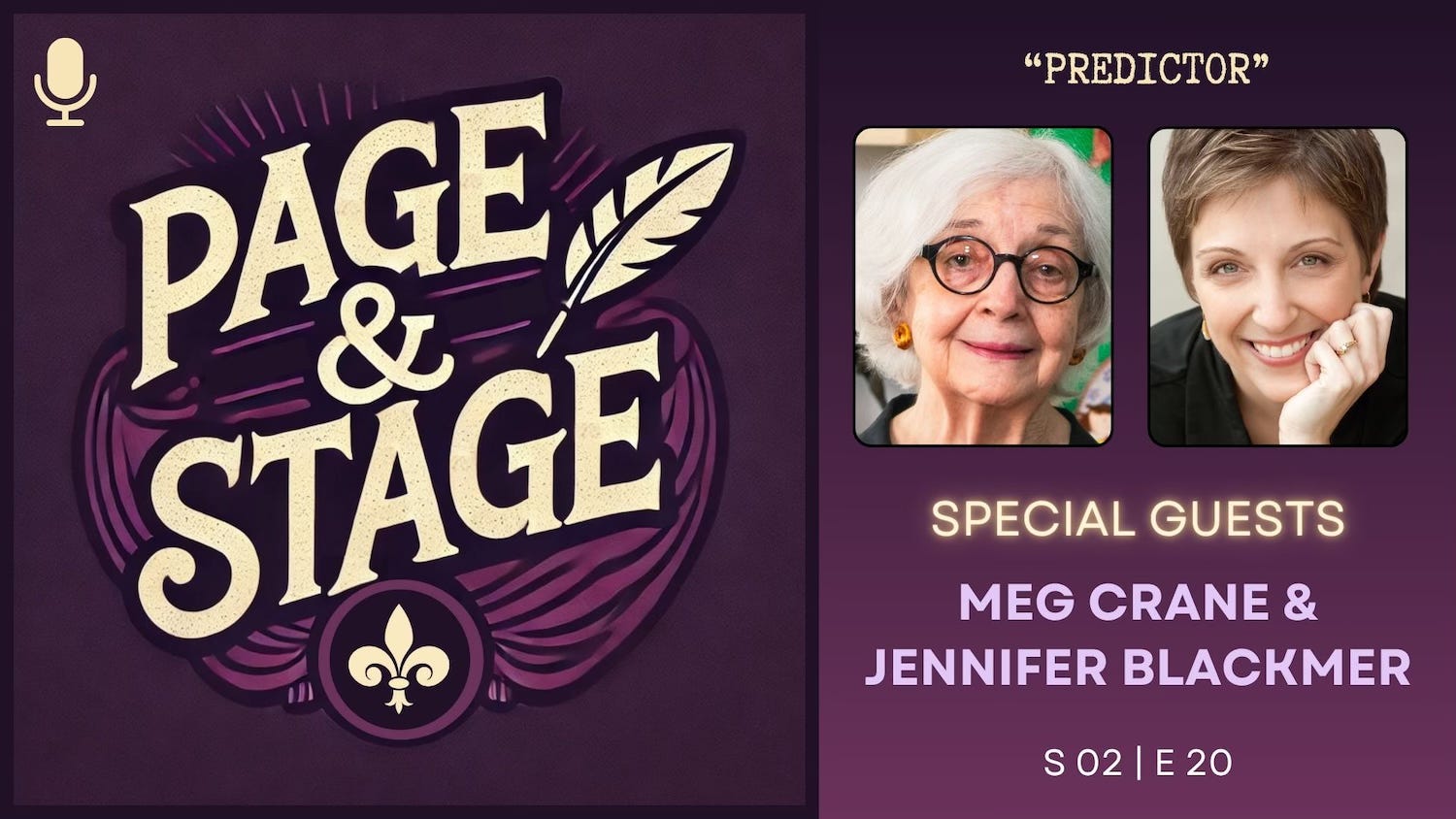
The next episode of the Page&Stage Podcast will land in your inboxes on Monday.
In this episode, I sit down with Jennifer Blackmer and Meg Crane to discuss the fascinating story behind the invention of the home pregnancy test. Meg shares her journey from working as a graphic designer and illustrator to developing a prototype that would empower women with the ability to test for pregnancy at home. Despite initial resistance and skepticism from (all male) executives, Meg’s determination and innovative thinking led to a groundbreaking product that changed the landscape of women’s health. Jennifer, the playwright of PREDICTOR, adds depth to the conversation by exploring how she adapted Meg’s story into a stage production, highlighting the intersection of art and science.
You can listen on the Substack App, and all episodes are also available on Apple or Spotify.
And if you want to put faces with voices, the video version will be available over on YouTube.
Be sure to comment or hit me up with any questions/comments/complaints, thanks as always for reading, and have a great weekend—
Jason “Music Man” Cannon
Jason, I appreciate your reminder that there's no one way to tell your story. Periodically, I remind my clients that your story should never sound exactly the same way with each telling. As you get more comfortable with the flow, you gain more insights into the characters. You also have a different perspective on the events, which means you'll have a different emotional reaction.
Your story should sound a little different each time you share it because it's getting deeper deeper into your bones, into your heart and into your soul
Mr. Rogers sang the slowest theme song every day he produced his children’s show on PBS. And by the third time they watched his “slow show”every kid could sing along with him and knew the words as well as the tune. A million kid versions of “Won’t You Be My Neighbor!” Sometimes Mr. Rogers stopped singing, and then spoke between phrases! Lovely anticipation, for every child watching!